I want you to imagine that it is September. There's a lot of fire season behind you, but still plenty in front. Today is just another day. Wake up, get chow, same ol' shit at briefing, don't forget to grab lunches.
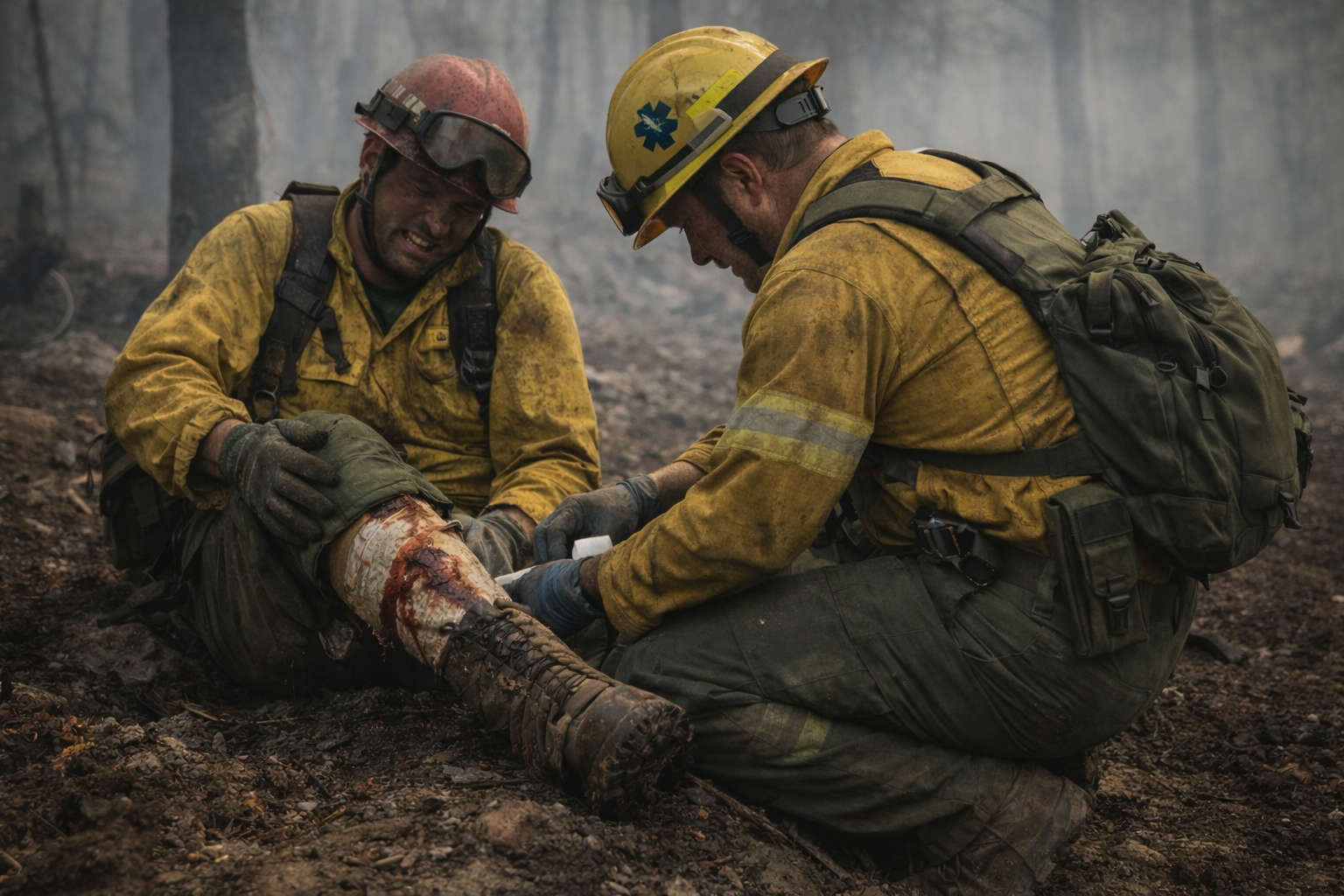
You get to your division, throw on your pack, line out with the crew, and begin the hike in to where you were yesterday. The hike in is about 3 miles, and the last bit is the worst. It's steep and has you stepping over dead and down. As you go to step over a thigh-high tree, you slip back and your leg slides forward and gets caught in the branches. Instantly you feel it — the loud "snap" and immense, unbelievable pain in your right lower leg. As you sit up to try and get your foot unstuck, you see it. The pearly white and pointed bone of your tibia is poking through your greens. You begin to scream. Your crew surrounds you and begins to help do what they can. "Call the medics," someone says. Your crew does what they can to straighten your limb, keep you calm, and control your pain. But there's nothing they can do that will help. The pain is agonizing. You didn't realize there was a level of pain that went that high. You'd give anything to make it stop. "The medic," you think. "Surely he'll have something to stop this hell." You think ahead to the hike down. You know you're going to have to be carried out over 3 miles to even get back to the road. You feel fear as you imagine your leg getting folded like a taco as your team does the best they can to move you carefully.
The Paramedic finally arrives after what seems like an eternity. Before he even tells you his name you say, "I NEED pain medicine."
He pauses and looks at you with a blank and shameful stare.
"I don't have any."
Pain Management is a Human Right.
On the fireline, that right may soon disappear.
That statement might seem obvious in a hospital or a city ambulance system. But in the world of wildland firefighting, where injuries occur miles from the nearest road and evacuations can take hours, pain management depends entirely on what the medical team carries into the field.
What I just wrote above is graphic and uncomfortable for some, but it is the reality that many of our country's wildland firefighters will experience this summer while out protecting the forest we love from the devastation of forest fires.
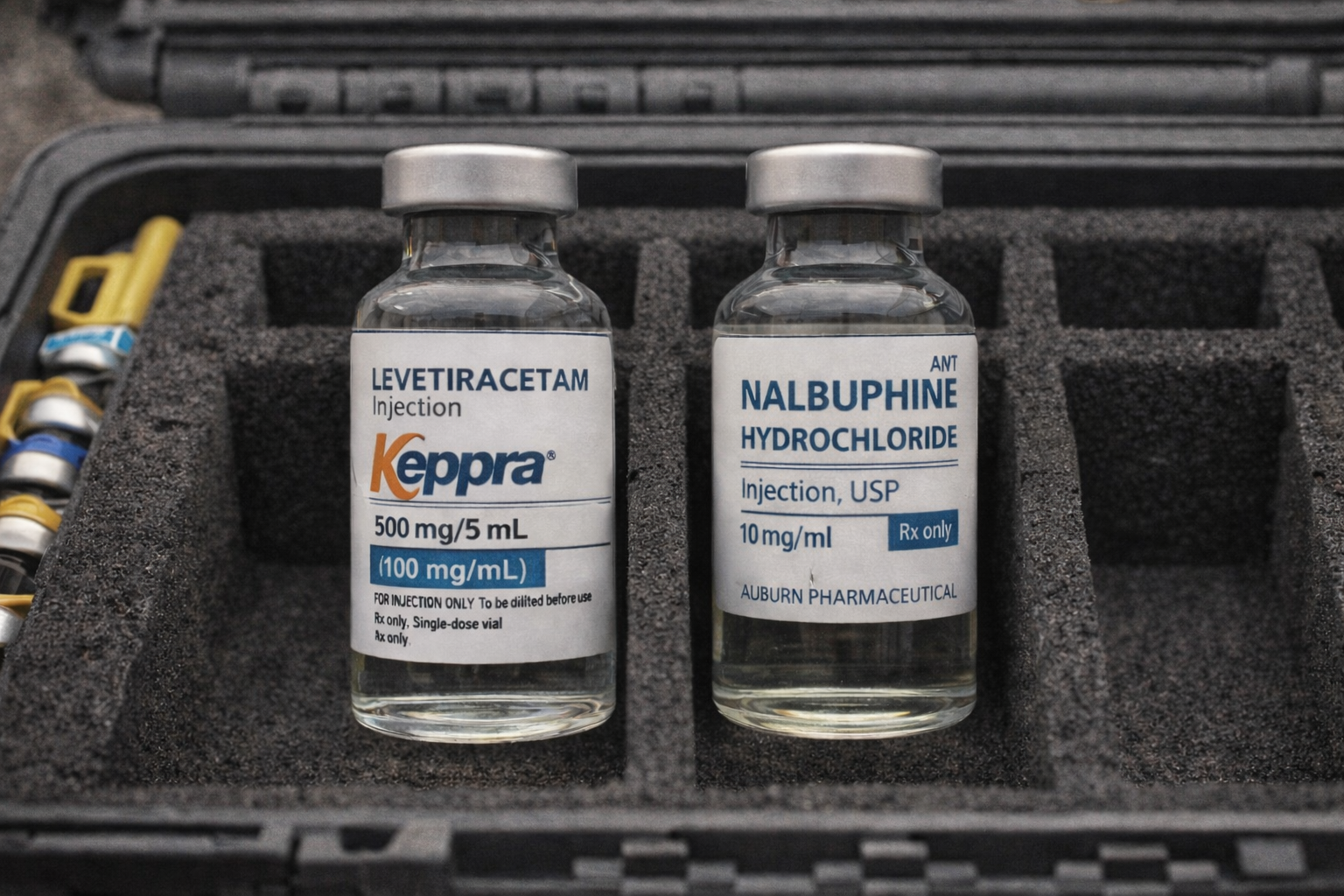
For wildland firefighters, EMS care is often provided by REMS teams, ambulances, or single-resource paramedics and EMTs. These providers historically carry medications like fentanyl, ketamine, and midazolam—drugs that allow medics to treat pain from severe trauma, control seizures, and manage critically ill patients while they are being evacuated from remote terrain.
Those medications are not a luxury. They are essential tools of modern emergency medicine.
A new federal rule has made it significantly harder for some wildland EMS teams to carry them.
The Problem with a State-by-State System
The DEA's final rule implementing the Protecting Patient Access to Emergency Medications Act (PPAEMA) was intended to improve oversight of controlled substances in EMS. In principle, the goal makes sense. EMS agencies should have clear regulatory pathways to obtain, store, and administer controlled medications safely.
The challenge arises when that framework meets the reality of wildland fire response.
Wildland EMS contractors operate under a national mobilization system. A team may start the season in Arizona, move to Oregon two weeks later, and then deploy to Montana or California depending on where fires are burning. These deployments often happen with only hours of notice.
Under the current interpretation of the rule, EMS agencies would be required to maintain separate DEA registrations in each state where they operate in order to carry controlled medications.
Here's the catch: you can't just "get" a DEA license. Well, not at least easily. In order to do that you have to jump through government hoops, over their red tape, and do just about everything imaginable outside of a blood sacrifice in order to get your EMS company a DEA license.
Here is a bit about the things you'd have to do in order to get your Wildland Fire EMS company a DEA license.
To even be eligible to apply for a DEA license, you must first be a licensed and registered EMS agency in the state you wish to apply for. While in some states it's relatively painless to become an "Ambulance Service," for example, Minuteman EMS is a totally legal and recognized EMS service in the states of Montana and Wyoming. In other states it is impossible to get an Ambulance service license unless you are a city or some other sort of municipality with a jurisdiction to operate.
Next, you would have to have a "brick and mortar" location (their words) in each state you wanted to have a DEA license in. Think of the nightmare (logistical and financial) of having to own or lease a physical location in 11 different states. I say "11" for the number of states there are in the West where it is likely you would find yourself responding as an EMS company.
Registration timelines can take months. Even if a company wanted to take on the Herculean effort of following the letter of the law to become compliant, the process could take months to over a year just for the DEA to do their side of the equation. So basically, for the 2026 fire season, we're fucked. Most all wildland fire EMS companies will not take on the risk of carrying these essential medicines for fear of breaking the law, losing their business, and destroying the lives of themselves and the employees who rely on them for a job to feed their families.
Lastly, but the least of the concerns for any of our companies is the license fees. It costs $888/state you wish to register in this. Speaking for myself and wanting to be able to do the right thing, I'd pay more than double that to just make this all go away.
What That Means for Patient Care
Serious injuries happen.
Broken femurs. Pelvic fractures. Crush injuries. Severe burns.
In those situations, the difference between carrying effective pain medication and not carrying it is enormous.
Without medications like fentanyl or ketamine, medics may be forced to manage severe trauma with little more than splinting and basic analgesics while a patient endures hours of evacuation through remote terrain. "Sorry about your burns bro, anyhow, here's some Tylenol."
No firefighter should have to experience that level of suffering if modern medicine has the tools to prevent it.
A Personal Perspective
This issue is not theoretical to me.
During the 2025 fire season, I experienced recurring seizures while operating in a remote environment on the Emigrant Fire. Our REMS team had midazolam in their tool kit, and they were able to terminate my seizures on the spot. It's crazy to think of what could've happened had my team not had that drug on them. In my case aircraft was available and transport was relatively quick. But if we had been in a different operational context—deeper in the backcountry or during poor aviation conditions—ground evacuation could have taken 3+ hours. Someone having uncontrolled seizures for that long is potentially fatal.
Imagine being a paramedic knowing how to fix the problem and stop the suffering in front of you, but you can't because of the way some bureaucrats wrote a few sentences in a law somewhere. In my opinion this leaves our medical providers vulnerable to moral injury and potential PTSD from the inability to act to your scope and the witnessing of unnecessary suffering.
Without that medication, my outcome could have been very different.
The reality is simple: controlled medications save lives and reduces needless suffering in remote environments.
Why This Matters
Wildland firefighters already accept enormous risk. They work long hours in dangerous terrain, far from definitive medical care.
What they should not have to accept is unnecessary suffering because the medics treating them are prevented from carrying the medications required to do their jobs properly.
Pain control. Seizure management. Procedural sedation. These are not luxuries. They are standard components of modern emergency medicine that are being taken away from us and therefore taken away from you, the wildland firefighter.
I am writing this to spread awareness to the issue, as I think it is the only way it will be solved. If you or someone you know may have some sort of political, legal, or other unique and beneficial connection, please reach out to me.
Thank you.